Custom ERP vs. Off-the-Shelf ERP: An Honest Guide for SMEs
When to use Odoo/SAP, when to build custom, and when a spreadsheet is enough. A decision tree based on revenue, workflow complexity and growth speed.
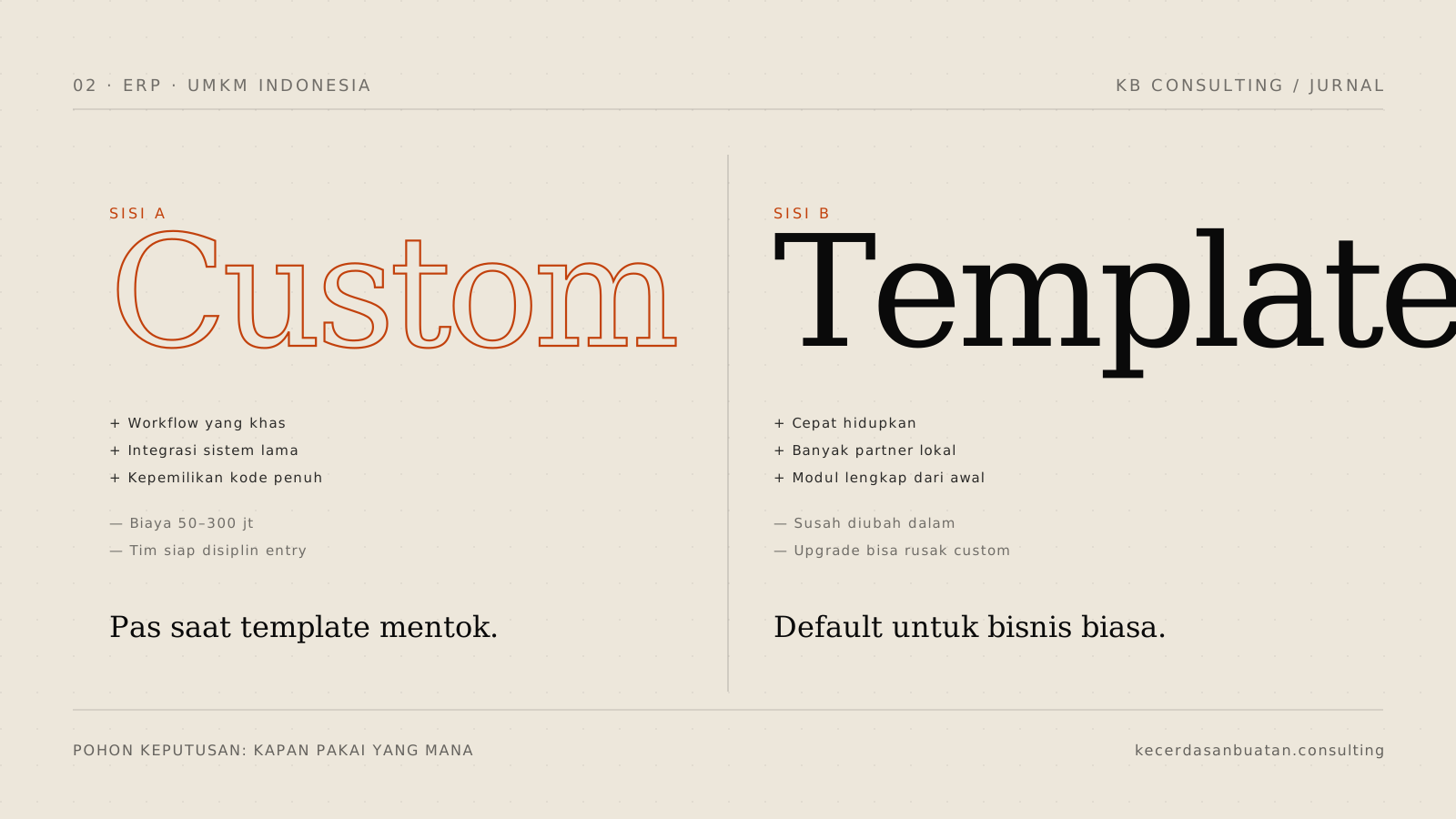
"Can you help build an ERP for my business?" — a question we get almost every week.
Our answer often surprises people: "You might not need an ERP."
Before spending tens of millions of rupiah on a custom ERP, it's important to understand when an ERP is worth it, when a spreadsheet is enough, and when an off-the-shelf ERP (Odoo, SAP B1) is the better fit.
This article is the honest decision tree we've used to advise more than a dozen SMEs over the last 2 years. Not every engagement ends with us building an ERP — sometimes we say "you don't need it, use the tools you already have first."
What is an ERP, really?
ERP = Enterprise Resource Planning. In short, one central system that handles many business functions: inventory, sales, purchasing, HR, finance, and more.
The key thing to understand: an ERP isn't magic. It's just software that collects your data in one place with consistent workflow rules. If the way your data gets entered is still a mess, an ERP won't save you.
The decision tree: spreadsheet vs. off-the-shelf ERP vs. custom ERP
Stage 1: Can you still operate on spreadsheets?
Stick with spreadsheets if:
- Monthly revenue is under IDR 500M
- Your operations team is fewer than 10 people
- You have 1–2 locations or warehouses
- Your workflow is relatively simple (buy → store → sell)
- You can still picture all your data in 5–10 Excel sheets
Spreadsheets can carry a business to IDR 1–2 billion in annual revenue for a simple business model. Don't underestimate them.
Signs you're starting to outgrow spreadsheets:
- 2 or more people edit the same sheet and conflicts happen
- Data is often wrong because of copy-paste
- You need reports that take more than 2 hours of data wrangling
- Stock-takes never match the records
Stage 2: When spreadsheets aren't enough — off-the-shelf first, or custom?
Off-the-shelf ERP options in Indonesia in 2026:
Odoo (Community / Enterprise)
- Community: free, self-hosted, needs a sysadmin.
- Enterprise: IDR 80–200k/user/month.
- Pros: complete modules, a large ecosystem, many partners in Indonesia.
- Cons: customization is complex, upgrades can break customizations, hosting/maintenance costs apply.
SAP Business One
- IDR 100–300M for an initial setup of 5–10 users.
- Pros: solid at mid-market scale, strong reporting, proven in manufacturing/distribution.
- Cons: expensive, heavy, implementation takes at least 3–6 months.
Accurate, Mekari Jurnal, Bee Accounting
- IDR 100k – 1M/month.
- Pros: cheap, designed for Indonesia (PPh/PPN tax, e-faktur).
- Cons: limited to finance + minimal operations. Not a full ERP.
Use an off-the-shelf ERP if:
- Your business is relatively standard (distribution, retail, simple services)
- Your workflow can adapt to the software
- Your team has capacity for 1–2 months of training
Consider a custom ERP if:
- Your business has unique workflows that templates don't cover
- You've already tried Odoo/SAP and hit a wall on customization
- Specific integrations are mandatory (IoT machines, marketplace APIs, legacy systems)
- You prioritize full control and code ownership
Stage 3: Custom ERP — when is it the right answer?
After many engagements, we've concluded that a custom ERP fits 3 scenarios:
Scenario 1: A distinctive workflow
A real example from one of our clients: a B2B distributor selling to 200+ shops, with a model of "take orders over WhatsApp → automatic invoice → delivery by freelance drivers → weekly collectors → cash reconciliation." Odoo couldn't accommodate freelance driver payroll + territory management + their particular collection cycle.
If, within a 10-minute workflow walkthrough, a template can't cover 70% of the requirements, custom makes sense.
Scenario 2: Tight integration with existing systems
Example: a mid-sized factory that already runs a legacy MES (manufacturing execution system). Integrating Odoo with a custom MES can cost more than building a custom ERP that's MES-aware from day one.
Scenario 3: Data ownership and sovereignty
In certain industries (healthcare, government-related, financial), full ownership of data + an on-premise database is sometimes not a preference but a requirement. A custom ERP on an open-source stack (Laravel + MySQL + Filament, for example) gives you full control.
What does a custom ERP realistically cost?
A breakdown for a modular ERP for Indonesian SMEs in 2026:
Per module:
- Inventory and stock-taking (1–3 warehouses): IDR 15–30M
- Sales and invoicing: IDR 15–25M
- Purchasing and POs: IDR 10–20M
- Receivables/payables (AR/AP): IDR 10–20M
- HR + attendance (WhatsApp integration possible): IDR 15–30M
- Payroll (following Indonesian rules: BPJS, PPh 21, PPh 23): IDR 20–40M
- Finance and automated journals: IDR 25–40M
- Custom reporting (dashboards, pivots, Excel export): IDR 10–25M
Total for a 5–7 module ERP for an SME with IDR 1–10 billion in annual revenue: IDR 80–200M.
Plus maintenance: 15–25% of the build cost per year.
Important: We recommend building in phases. Phase 1: the 2–3 most urgent modules (usually inventory + sales + purchasing). Go live first and let the team get used to it. Phase 2: add 2–3 more modules 2–3 months later. A modular approach carries far less risk than a big-bang release.
When is "just use a spreadsheet" the right answer?
A counter-intuitive answer for a studio that sells ERPs: sometimes we tell clients "not now."
Signs you aren't ready for an ERP:
-
Your master data isn't clean. Item codes, customer names, units, prices — all still jumbled across sheets. An ERP will only amplify the mess.
-
Your operations team resists change. An ERP demands disciplined data entry. If your admins and staff aren't committed, you'll end up "paying for expensive software while the data still lives in WhatsApp."
-
You can't yet explain your own workflow. If you can't explain your company's SOPs to a vendor, the vendor will guess — and their guesses usually miss.
-
Your business still changes direction often. If your business model shifts every 6 months, a custom ERP becomes tech debt. Use spreadsheets + Notion/Asana until the model stabilizes.
Our advice for readers
Revenue < IDR 500M/month, team < 10 people:
- Spreadsheets + Accurate (finance). Total: IDR 500k/month.
- A IDR 50M budget for even the smallest automation isn't worth it at this scale. Your time is better spent on growth.
Revenue IDR 500M – 5 billion/month, team of 10–50 people:
- Start with Odoo (Community if your team can host it, Enterprise if not).
- If Odoo hits a wall on 2–3 essential custom features, consider custom modules — not a full rewrite.
Revenue > IDR 5 billion/month, team of 50+, distinctive workflow:
- A modular custom ERP. Build phase 1 (2–3 modules), validate, then expand.
- Consider SAP Business One if you want a branded solution + your team has used SAP before.
How we help at KB Consulting
We build custom ERPs for Indonesian SMEs with a modular approach — build the most urgent modules first, go live, iterate. Stack: Laravel + Filament (admin panel) + MySQL. Self-hosted or in the cloud.
Our process starts with a free 30-minute initial conversation where we first assess whether custom is worth it for you — or whether another solution (Odoo, Accurate, even a spreadsheet) is a better fit.
We mean it when we say "we won't say yes to everything." Some of our best clients are the ones we pointed to another solution when custom wasn't right yet, who came back 1–2 years later once their scale justified a custom build.
Want to discuss whether your business suits a custom ERP, an off-the-shelf one, or is still fine on spreadsheets? Chat with us on WhatsApp for a free consultation.
Written by Tim KB Consulting
Discuss this topic on WhatsApp