How Much Does It Really Cost to Build a Startup MVP in Indonesia? [2026]
An honest breakdown of MVP costs: from an IDR 8M landing page to a IDR 200M multi-tenant SaaS. Plus the red flags of prices that are too cheap or too expensive.
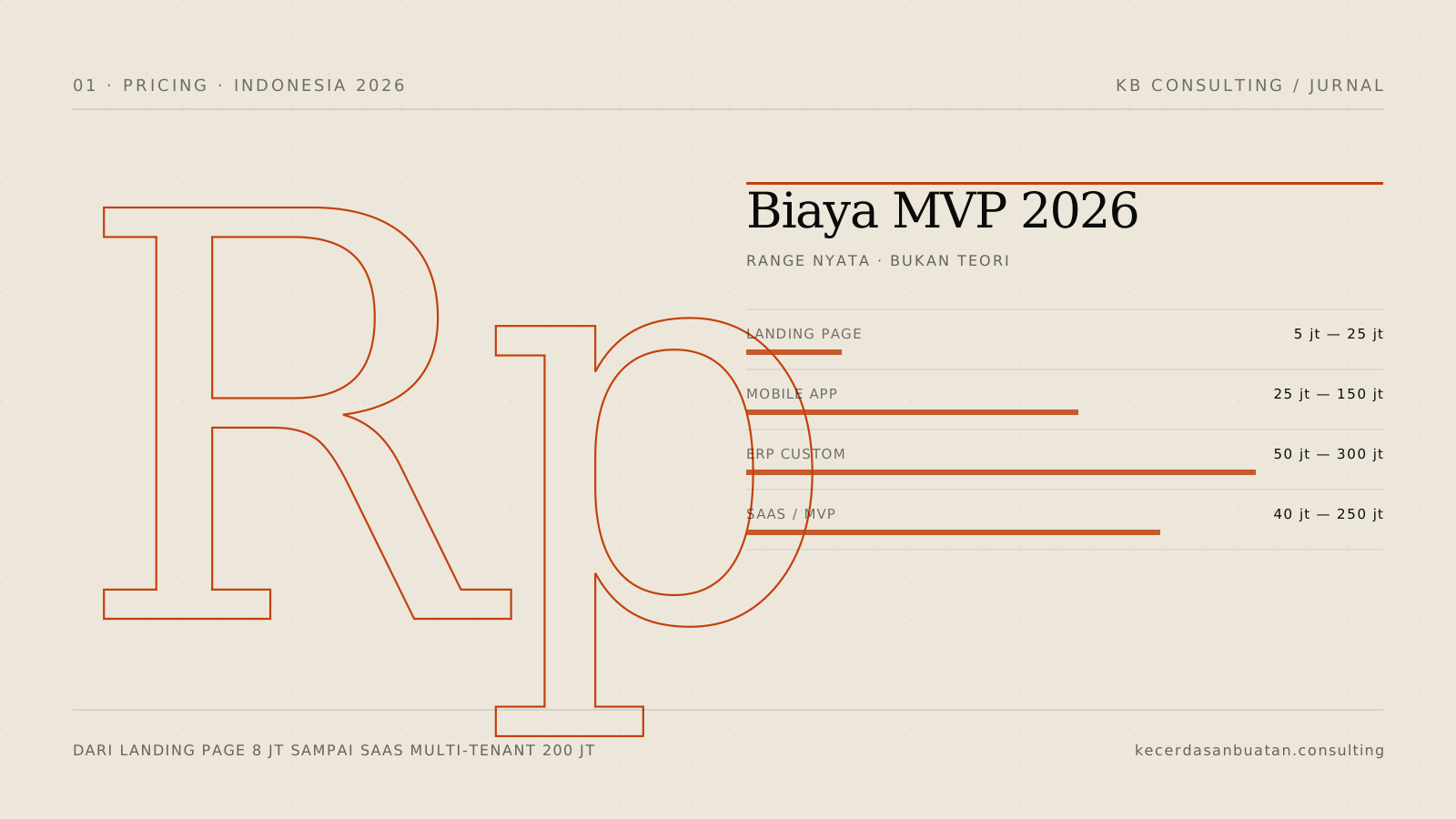
"How much does it cost to build an app?" — that's the question that lands in our inbox most often. The honest answer: it depends. But "it depends" is an answer that helps nobody.
In this piece we break down real price ranges for an MVP in Indonesia in 2026, based on projects we've delivered plus an informal survey of other studios.
The goal is to help you prepare a budget before you meet an agency's sales team, and to recognize the red flags of prices that are too cheap (which means quality is being cut) and prices that are too expensive (which means the vendor is padding its margin).
2026 price ranges by product type
Landing page / company profile
IDR 5M – IDR 25M
- Template (IDR 2–5M): a WordPress/Elementor template with light customization. Enough for an SME profile.
- Custom design (IDR 10–20M): original design, SEO-ready, a CMS so you can update it yourself, responsive.
- Custom design + complex animation/interaction (IDR 20–40M): Next.js / Framer Motion, form integrations, multilingual.
Timeline: 1–4 weeks.
Red flags: a price below IDR 3M is usually a resold WordPress template plus the domain fee. Over IDR 50M for a landing page alone = overkill, unless you need enterprise integrations.
Mobile app (iOS + Android, one Flutter codebase)
IDR 25M – IDR 150M
- Simple app (IDR 25–50M): 5–8 screens, basic CRUD, simple authentication, published to the Play Store/App Store. Examples: a directory app, basic booking.
- Mid-level app (IDR 50–100M): 10–20 screens, payment integration, push notifications, complex APIs, offline support.
- Complex app (IDR 100–200M): real-time features (chat, video, live location), heavy integrations (IoT, AI), multiple user roles.
Timeline: 4–12 weeks.
Red flags:
- Under IDR 20M for Android + iOS = usually built with no-code (FlutterFlow/Bravo), which is hard to extend later.
- Over IDR 300M for an MVP = get a second opinion. It can make sense (complex AI, custom native work), but ask for the scope in detail.
Custom ERP (SME scale)
IDR 50M – IDR 300M
- 3–5 core modules (IDR 50–100M): inventory + sales + purchasing, for example. Single tenant, 1–5 concurrent users.
- 6–10 full modules (IDR 100–200M): add HR, payroll, attendance, finance, multi-warehouse.
- Enterprise scale (IDR 200–500M): multi-entity, multi-currency, complex approval flows, tight integration with existing systems (SAP, Oracle).
Timeline: 8–24 weeks (usually modular, in phases).
Red flags:
- "Complete ERP, IDR 5M per module" = a resold Odoo template. The moment you need customization, things get painful.
- Over IDR 1 billion = you're probably better off with Odoo/SAP, or seriously weighing buy vs. build.
Booking system
IDR 15M – IDR 80M
- Basic (IDR 15–30M): slot calendar, forms, email confirmation. Enough for a small clinic or salon.
- With payments (IDR 30–50M): deposits via Midtrans/Xendit, refund handling, automatic reminders.
- Full (IDR 50–100M): multi-location, multi-staff, resource management (rooms, equipment), official WhatsApp API integration.
Timeline: 3–8 weeks.
Red flags: under IDR 10M is usually a reskinned template that's hard to adapt. Pay attention to code ownership.
SaaS / custom startup MVP
IDR 40M – IDR 250M
- An MVP focused on 3 core features (IDR 40–80M): enough for a soft launch to 20–50 early users and a market test.
- MVP + mobile app (IDR 80–150M): if the product is genuinely mobile-first.
- Multi-tenant SaaS (IDR 150–300M): billing, tenant isolation, admin and super-admin panels.
Timeline: 4–16 weeks.
Red flags: a "cheap" SaaS under IDR 30M = most likely single-tenant, with architectural tech debt that becomes a nightmare when you scale.
What pushes the price up or down?
After dozens of projects, the pattern is clear:
What pushes the price up:
- Complex third-party integrations — every payment, shipping, accounting (etc.) integration adds 10–30% overhead.
- Real-time features — chat, live updates, push notifications = different infrastructure and a different engineering skill set.
- Regulatory compliance — PDP, PCI-DSS, HIPAA-equivalent = add 20–40% for audits and hardening.
- Custom design (not a template) — can add 20–50% depending on complexity.
- Unlimited revisions in the contract — when scope is unclear, agencies raise the price to cover the risk.
What brings the price down:
- A focused scope — 3 core features first, 15 features later.
- A mature stack (Laravel/Next.js/Flutter), not an experiment.
- Finished designs from your own Figma, rather than the agency designing from scratch.
- Content ready from your side, rather than the agency writing the copy.
- An AI-assisted workflow — studios that use AI seriously for code generation can work 2–3x faster, and pass that saving on to the client.
That last point matters — it's what lets us at KB Consulting keep prices reasonable. We use an AI-assisted workflow not to churn out careless code, but to help with scaffolding, writing tests and reviews — while architecture and final review stay in the hands of human engineers.
Pricing models: the 3 ways vendors sell
1. Fixed price
A contract with a clear scope and price up front. A good fit for an MVP whose scope is already sharp.
The risk: scope creep. If you ask for additions mid-project, an extra invoice follows.
2. Time & material
You pay for the hours actually worked. Indonesian developer rates in 2026:
- Junior: IDR 75–150k/hour
- Mid: IDR 150–300k/hour
- Senior: IDR 300–500k/hour
- Architect/Lead: IDR 500k–1M/hour
The risk: costs can balloon if the vendor is inefficient or you aren't monitoring.
3. Pay after delivery (rare)
The model we use at KB Consulting. You pay once the MVP is built, tested, and you're convinced.
Why we can do it: this model only works when a studio is confident in the quality of its own work, and has the cashflow to fund the build without a deposit. We chose it because we're confident — and because it's the fairest model for founders whose idea hasn't been validated yet.
Hidden costs people forget
When you budget, don't forget:
- Hosting and infrastructure — AWS/DigitalOcean/Vercel, usually IDR 500k – 5M/month for an MVP.
- Domain + SSL — IDR 150k – 1M/year.
- Third-party services — Midtrans fees, email (SendGrid/Resend), SMS OTP, the official WhatsApp API.
- Maintenance — a rough rule of thumb is 15–25% of the build cost per year. Or a monthly retainer.
- Marketing — an agency builds the app, but it doesn't bring you users. A launch marketing budget is usually 50–100% of the build cost.
Conclusion: how much should you budget?
Rough benchmarks for an already-validated startup MVP:
- Landing page + waitlist test: IDR 5–15M total
- Simple MVP (a small site/app): IDR 25–60M total
- Mid-level MVP (full mobile app + backend): IDR 60–150M total
- Complex MVP (multi-tenant SaaS / platform): IDR 120–250M total
Plus a 20% buffer for post-launch iteration + 6 months of operating costs.
If these numbers surprise you — that's normal. It's exactly why the pay-after-delivery model we use matters. You don't need to have IDR 100M+ ready up front; you commit once the MVP has been tested and you're sure the product delivers value to users.
Want to talk through the budget for your specific project? Book a free 30-minute consultation on WhatsApp or see the price ranges for each of our services.
Written by Tim KB Consulting
Discuss this topic on WhatsApp